Tuesday, 15 June 2010

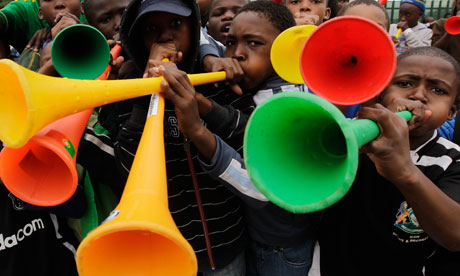
Boredom’s joy: the music of the vuvuzelas


Football is one of the world’s most boring sports, for the fan the boredom being attenuated by constant gnawing tension that is enlivened by anger, rage, moments of euphoria, incredulity and despair. Or at least that’s my experience living in England. For amusia, however, the current world cup is a constant joy because of the general annoyance caused to the world’s broadcasting networks and much of its global audience by the mass buzzing of the vuvuzelas, major networks having lobbied FIFA to get the Thing banned. Sepp Blatter, FIFA’s President has refused, however, letting his German unconscious do the talking when he avers, liberally, that ‘I have always said that Africa has a different rhythm, a different sound’. Remarkably unifying the extraordinarily diverse and geographically remote nations and cultures of Africa, the sound of the vuvuzela nevertheless becomes the universal sound of ‘Africa’s’ specific mode of enjoyment, the rest of the world’s noisy neighbours. For Blatter, it seems, the Africans should be allowed their exotic mode of enjoyment for our enjoyment. People are annoyed, but at the same time annoyed with themselves for being annoyed, the only recourse being to point a liberal finger in the annoying mirror of annoyance. The vuvuzela is ‘only annoying to the annoying’ says a caller to BBC Radio 5, annoyed by white middle-English intolerance.

The vuvuzela is the South African name (apparently derived from a Zulu word) for a stadium horn that has been around for years – in Brazil it is apparently known as cometa. In this world cup, however, it has indeed taken on a new dimension. It is not simply that the vuvuzela is South Africa’s ‘12th Man’ in the tournament as this report suggests. One is tempted to sound all D&G and speak of a plane of intensity or a human-horn assemblage becoming elephant becoming hive etc. etc, the crowd producing a sonic war machine that transforms the site and sound, the whole milieu, of world cup football. The music of the vuvuzelas drowns out applause, cheers, singing, conventional means of support; on the field, players exhausted through lack of sleep having been kept awake by all night vuvuzela parties, cannot hear each other above the din produced in the stadium, described as a massive beehive.

But for the neutral South African supporter, what is watching a boring football match between England and the USA, say, and blowing on a vuvuzela in unison with thousands of others? The buzzing of vuvuzelas is only a mode of ‘African’ enjoyment where it becomes the (phallic) signifier of all the lost enjoyment of TV viewers, especially in the West. But I’m not sure there is anything specifically African or even South African about the stadium horns. An effect of spaces real and spectral, actual and remote, these thousands of thin plastic phalloi vibrate spreading viruses and tele-techno annoyance around the stadium and around the world: they are the pipes of boredom’s joy. Jamie Carragher on TV last night says his kids have demanded that he bring a bunch of them home. Better than the world cup.

Thursday, 10 June 2010

The London Graduate School


No doubt you will have followed the campaign to save Middlesex philosophy, which has galvanised an international community of scholars and thinkers. With yesterday's announcement of the transfer of Middlesex's Centre of Research in Modern European Philosophy to Kingston University, the struggle to preserve a future for critical thought in London (something all of us have been engaged in, in different ways), and indeed beyond, now enters a new phase. The imminent launch of a London Graduate School, devoted to renewing the intellectual project of the University, fostering a new spirit of the public sphere, and inspiring new forms of intellectual and cultural practice, is to be accompanied by an inaugural lecture given by Gayatri Spivak in the Large Common Room at 6-8pm 21st June at Goodenough College, London. This will provide the opportunity, we hope, to bring together or at least make possible something like an Estates General in London.

As co-directors of this new initiative, Martin McQuillan and Simon Morgan Wortham would like to invite you to this event. All welcome.

Friday, 7 May 2010

DG 003580 NS

IN SACRIFICE, beauty’s perfection points to death’s full brutality. Double-take. At first glance, it is as if the veiled woman is warding off the camera, the hennaed hands not so much a blessing as a curse. But it is the backs of her hands that are visible, of course, splayed out and thrust towards the camera lens in pride and supplication, the tattoos perhaps signifying a forthcoming marriage. But then again, these hands are so much in the foreground that they are positioned in the picture almost as if they were ‘our’ hands – or indeed the photographer’s hands that should be taking the photo. It is as if we have suddenly dropped our camera in order to hold back some sinister apparition looming up from behind the glass. The blurring of the picture gives this sense of double movement, pushing back and forward, thrusting and repelling. A woman beautified, ceremonially painted-up, adorned, veiled for someone’s delight, looks ominous. ‘We’, similarly adorned, hold back, with our hennaed hands and our slender pointed nails, our double, our darkened image. The composition of the picture sets up this equivalence, this Iranian stand-off, conveying our gaze directly into the eye-line of the woman framed in the blackness of the veil. One eye, obscured behind the reflected flash of light, the other – the evil one, no doubt – looks directly at ‘us’, at me, behind thick eyeliner. ‘As we are about to take the final step, we are beside ourselves with desire, paralyzed, in the clutch of a force that demands our disintegration’ (Bataille). Hands are held up against the translucent barrier and the dark figure behind it. What denotes the glass barrier, if it is glass, is the reflected light and, in the top left-hand corner, where the left index finger points, some painted writing. Whatever it is, writing signifies that there is Law somewhere, and here, as ever, it marks the point of separation, all points of separation, between light and dark, subject and viewer, beauty and its profanation, woman and woman. Because I must remember that the woman does not look at an ‘us’. These hands at the foreground of the picture address another woman – the photographer – as if in challenge and complicity, each woman looking the other in the eye. What do they see – each other’s life, love and beauty, or death? In her place, looking enacts sacrifice. S

Monday, 3 May 2010

DG 003510 NS

Sequined sea of space-time / the multiple / an apparition of forms. Immersed, neither inside nor out, how can I tell that this doesn't go on forever? Undulating, an iridescent mirage that discloses nothing but desert without end or horizon reaching from the earth to the farthest heavens, extending to remotest space, countless particles multiplied as often as there are leaves in the forest, feathers upon birds, scales on fish, drops of water in the mighty ocean, atoms in the vast expanse of the air ... How much do I love thee? Let me count the ways ... Love is of course the immeasurable and the unaccountable. It's not the sequins that she wears, it's not her baby-fine blond hair, it's more the desert in her stare (Iggy Pop). The truth of desire discloses itself as nothing but semblance. But what is this auto-disclosure? Desire of course transcends the object, directed by the semblance of being immanent to it. Desire is always directed towards another desire which, without mediation or regulation, replicates itself endlessly in sequences so that desire is desire of desire of desire of desire of desire of desire ... Not signifiers but sequins: no longer zecchino, medium of exchange, but pure metonymy, pure sequentiality without order of priority or narrative, flickering in the full nothingness of evacuated exchange-value, the empty plenitude of digitality. Who could make a metaphor of it? Who would turn this multiple into the likeness of One? She puts on a universe comprised entirely of sequins strings, patterns emerge – life seems to glisten in semblants of being – in folds and clusters, in degrees of intensity, in the fabric of space/time, to arouse the desire of God, who names her the Universe, the One. But she is la belle noiseuse, querulous beauty (Serres), flashing eyes and glinting hatred: noisily not (not) one she ex-sists in the domain of the infinite with which she is continuous. Glistening jouissance, pure surface – not of the repetitive circuit of the drive (the brickwork, the crumbling walls, the undead historical process that goes nowhere) but in the en-corps (Lacan) which insists in the body beyond its sexual being (Seminar XX). 'It is in the traces of jouissance inscribed in this en-corps that we can, perhaps, discern something of the poesis—the something coming from nothing—that Lacan links to the contingency of being and, ultimately, to the path of love' (Suzanne Bernard). S

DG – 003506SE

‘In the mirror I discover my absence from the place where I am’ (Foucault). A photographer, is this the photographer? At first sight, naively, it looks like a photograph of a woman, the street behind her, taking a photo of some desirable object in a shop window. But it could be a reflection, yes, the glass is angled relative to the picture plane; the photographer is the ‘desirable object’ looking at herself in the ‘shop window’. Even if it is not a reflection, this is the ruse of the double, setting up the desire to photograph the photographer looking at herself looking at herself. And here I am like her – like anyone – in the place where she discovers her absence, looking at herself looking at herself. The place of the shopper and the commodity is the same. Her left eye, not the camera lens, seems to look into that space from which she is now absent and from which I am looking, being drawn into this play of glances, this exchange of narcissisms. It is a look of intimacy, but it is not intimate. A smile plays on the photographer’s lips as she glances at herself and through herself into the virtual point, the empty space not of symbolic mediation but economic exchange, from which I look back at her. I notice the fractures in the glass hinting at the disunity of the body that is normally veiled by the specular image but is here disclosed. I fragment in turn. This commentary is too facile, don’t you think? I see a hurried yet studied impersonation of feminine desire. On impulse, she pulls back the thick curtain, as heavy as death, unwinds her veil, takes a quick snap of something that catches her eye (herself). Transgressive feminine jouissance is on display even as it takes place out of the sight of the King and his police (Purloined Letter, again). It is not an image of female narcissism, but an advertising of feminine desire and jouissance that appeals to the narcissism of the viewer, his idiotic cleverness. This is desire pimping itself in the form of its own semblance all the better to remain hidden. Abject, I don’t know how long I can go on playing the role of the (Lacanian) punter. It is time to unwind that veil, but what is behind it? Nothing but another semblance of an imitation of a semblance ... S

Saturday, 1 May 2010

DG – 003505 DS

A trunk and a package of junk, tied with string. Let’s go. They do not move. ‘S’ is the letter that denotes me in this glossing game. And here is ‘my’ letter stencilled on a cardboard box flattened to provide some loose casing for – what – wrought iron gates, a fence? This picture, which falls to me by the law of numerical series and sequencing that allots my place, has ‘my’ letter on it prominently placed and underlined. But of course this picture has absolutely nothing to do with me. I have never seen this alley, street or those objects. Then again, what does the letter ‘S’ have to do with me? Arbitrarily, according to the rules of the game, I am put into the picture as the letter ‘S’, a letter as alien to me as this picture. Has someone arrived or are they about to travel? Has someone died? (1) ‘S’ is visible but at the expense of ‘me’ who am absent, like the owner of these objects. ‘The signifier, whose first purpose is to bar the subject, has brought into him the meaning of death. (The letter kills, but we learn this from the letter itself’) (Lacan). The letter marks the point of division wherein one locates one’s place as an effect of the chain, SAEND, arranged in couples at four corners, ‘in a form homologous to a pyramid’, a tomb. It is this form of fatal couplings that determines the destiny, if not the destination, of ‘my’ desire in the context of this game. Appropriately the image seems to comprise, again, of a series of dualities: a dark alley, an opening, where all the lines tend, into the light. Propped up against the wall, the objects look set to travel, but just sit there. This could simply be a pile of rubbish. I see a couple, although there are many more than two objects: the sealed trunk, smug, inscrutable, sphinx-like; the other(s) ragged, dishevelled, letting it all (nearly) hang out. A game of even and odd couples: Oscar and Felix, Jacques and Jacques, Félix and Gilles, Didi and Gogo. Didigogo? No, he did not move. Yet desire is movement even in stasis; it is anticipation, imaginary flight, fantasy; La lettre volée, while the objects remain. (2) I see a trunk and a wrought iron-cardboard-string machine bearing a letter that has arrived by chance, as always, at its destination. S

(1) When I first saw this image I was reminded of Freud’s tattered hat and coat that hangs above a weather-beaten monogrammed suitcase in the Freud Museum in Vienna. These signs of imminent departure are virtually all that is left of Freud in the house from which he fled from the Nazis. Almost everything in that house is now in Hampstead. But these objects did not leave, they were abandoned.
(2)‘By The Time I Get to Phoenix’ is a song of imaginary flight. It is another repetition in a series of failed departures – ‘I’ve left that girl so many times before’. His anticipation is always displaced by nostalgia, the (love) sickness for home. ‘By the time I get to Phoenix, she’ll be ...’ but he never gets to Phoenix.

dESIRE gloss: DG – 003501 SA

[These brief commentaries are part of a five-sided, pyramidal gloss on a series of photographs (for other examples see The Whim). It is forbidden to reproduce them here; they must be imagined.]

Desire and the drive: A Persian tale baked upon an arch made of brick. Que vuoi? I don’t know anything about photography. I don’t know anything about the photographer except that she is American and has an Iranian partner. What does that have to do with anything? Are all these photographs taken in Iran? I don’t know anything about Iran, couldn’t identify a monument, square, rock. We think you know a lot about desire. This is the last, terrifying sentence on the email from N, inviting me to participate in this project. Who are we? And what do they suppose about my knowledge of desire? I’ve written on Lacan. But the page mock-up, determining the length of each gloss, consists entirely of repeated denunciations of psychoanalysis in favour of Deleuze and Guattari! Already my looking has been pre-directed by an imagined dichotomy I reject. This picture, the first one allotted to me, I cannot see now as anything but a staging of the question of desire, in a picture structured by a series of dualities, too many. But mainly: two planes and surfaces, ceramic tiles and whitewashed brick. I am struck by the awkwardness of the framing that truncates the images glazed on the tiles and makes the nature of the building difficult to read. (Already visual desire is provoked through a brutal act of photographic ‘castration’!) Modern (Western) consumer desire finds its origin and definition in eighteenth-century Orientalism in a fantasy of despotism and Other jouissance: The Arabian Knights but also Montesquieu’s Persian Letters (1721). Scheherazade’s 1001 glosses, wagering life on the desire of the Other, for ‘desire is interpretation itself’ (Lacan). Who is he, horseman of desire with his train of followers, is he laying siege or coming home to the golden citadel I imagine in the top corner, the point towards which all the lines tend? Visual desire is related to the scopic drive that is all the more deadly and machinic for being photographic, click after click, picture after picture, arching around a vacuole in brick-like, stolid satisfaction. But the desire that this drive supports, I wager (but we will see), is not to picture, objectify or possess Iran or Iranian objects, but to ‘operate on a sacrificial plane’ and arouse Iranian desire itself, ‘for what makes the value of the icon is that the god it represents is also looking at it’ (Lacan). S

1. Which illustrates interestingly how the East and the West – the Orient and the Americas – could, in the 18thC, be related in a triangular structure that connected virtue with erotic and economic value.