Saturday, 17 April 2010
Buzz Factory
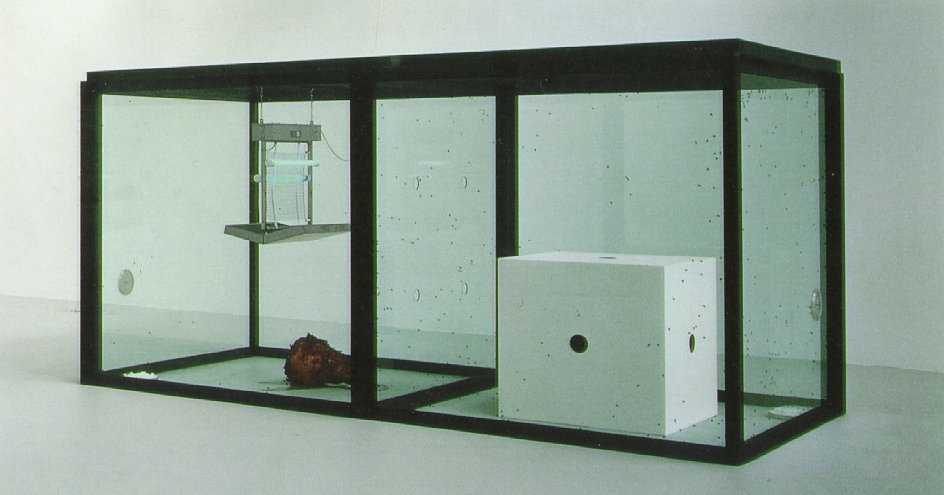
Given the ubiquity of musca domestica, flies have been a wonderful example of this neighbourly economy of jouissance from King Lear to the Cramps, Kurt Neumann and Cronenberg to Wire. Not ‘hurting a fly’ is the acme of Christian pity and Buddhist piety, being ‘a fly in the ointment’ is the desire of anyone hoping to subvert a repressive system, and so on. No doubt since the migration of homo sapiens from Africa, musca domestica have been the constant companions and noisy neighbours of human beings, lodging in the margins of human civilization, incubating and pupating in its shit and garbage, feeding on wounds and rotting flesh, defecating and vomiting waste matter teeming in deadly bacteria and viruses: typhoid, cholera, dysentery, tuberculosis. The House Fly is, therefore, a perfect object of ecological desire, named after the oikos, dweller in our house and environment, living off the waste products that define and embroil every culture: s/he is my constant companion, a neighbor with whom I share my home, but who does not treat it like one; a partner with whom I identify, but who is also other to me; an in-human double who’s annoying buzzing presence indicates that she enjoys herself too much at my expense, and whose body I can in turn enjoy in compensation by squishing her; a creature that I cannot help both love and torture for making me suffer.
Damien Hirst’s artwork A Thousand Years (1993) continues this tradition: a large steel and glass display case is divided in two by an interior pane with four holes cut into it. Inside, on one side, a rotting cow’s head infested with maggots sits beneath an ‘insect-o-cutor’; in the other is a white MDF box. As the maggots pupate into flies the chances of their generally limited average life span of around 7 days is curtailed. Most would die on their maiden voyage. Some, however, will make it through the holes into the relative safety of the adjoining case containing the white box. In the corners of both cases are dishes of sugar and water. It is a machine for killing flies, while offering the chance of a number of flies living out their lives, mating, reproducing and so on. Certainly enough survived to sustain the process. As a work of art, it invites identification as it offers the art lover the opportunity to view the whole lifespan of a creature from birth to death in a way that, even under confined conditions, owes much to chance and individual ‘choice’. As Timothy Morton writes of Blake’s poem, The Fly, Hirst’s work sets up a dual process of identification with ‘the “evil” (the “thoughtless”, “blind” mechanical operation [of the insect-o-cutor] and with the insect’ (Morton: 202).
Evil is certainly evoked in the title of Hirst’s piece, A Thousand Years, recalling the ‘thousand year Reich’ promised by the National Socialists in Germany. Given this, it is impossible not also to see in Hirst’s piece a reference to Auschwitz. But this is not just an extermination machine, this is also a breeding factory and a sustainable environment. Hirst thus brings out continuities between art, fascism and the ecology management of animals. The piece evokes Auschwitz, but also the increasingly industrialized ways in which animals are bred in captivity for slaughter; and not just bred, but by extension these days artificially inseminated, genetically manipulated and produced. The correlation between this and Auschwitz invites the contemplation of greater horrors: imagine, ‘for example, instead of throwing people into ovens or gas chambers (let’s say Nazi) doctors and geneticists had decided to organize the overproduction and overgeneration of Jews, gypsies, and homosexuals by means of artificial insemination, so that, being more numerous and better fed, they could be destined in always increasing numbers for the same hell, that of the genetic experimentation or extermination by gas or fire’ (Derrida, ‘The Animal That Therefore I Am’). This is, perhaps, the darkly satirical element to the work. But precisely as such, ecological desire is provoked and affronted by the way in which the work relies on the equally dark correlation between flies and human beings made for example by deep ecologist Arne Naess when he asserts that ‘I will never say I have a higher right to life than a mosquito’, mosquitoes of course having been ‘responsible’ over the years for millions of human deaths -- deaths that are no doubt essential if the balance of life on earth is to be maintained in the face of human over-population. Poised between the solar death of the insect-o-cutor and the nuturing corpse of the earth, the fly-humans live out their brief allegorical lives in a utopian-dystopian sustainable environment as an art work.
While there is no need to speculate about authorial intention, one is tempted to ask, following Schopenhauer, what exquisite sensitivity must Hirst possess to require the audacious buzzing of flies to be compensated by the music of its eternal annihilation. Buzzzzzap! Sizzle; the soft fall to the floor of the fly-corpse. Hirst’s fly amusia balances his suffering against the extermination of both humans and flies (imagined or real) on the plane of aesthetic enjoyment. What Hirst has nevertheless produced is a mean machine for both realizing ecological desire and satisfying its death drive. The machine produces happy flies pupating in an ideal environment (the rotting carcass), feeding on sugar, flies that one might identify with and love as people, flies endowed with human ‘choice’ and a singular destiny as to the time and manner in which they live and die. They can fly through the hole to safety or they can fly too close to the insect-o-cutor and be zapped. The fact that many do the latter maintains the fantasy of ecological balance. Imagine the congestion without it. Furthermore, perhaps, future adaptation will result in evolved avoidance of insect-o-cutors etc... This is to say that the ecological art lover can contemplate in satisfaction the management of his noisy neighbour’s jouissance even as the death drive is sustained through the sound of perpetual buzzing annihilation.

Subscribe to:
Posts (Atom)
